Tesamorelin
Showing the single result
-
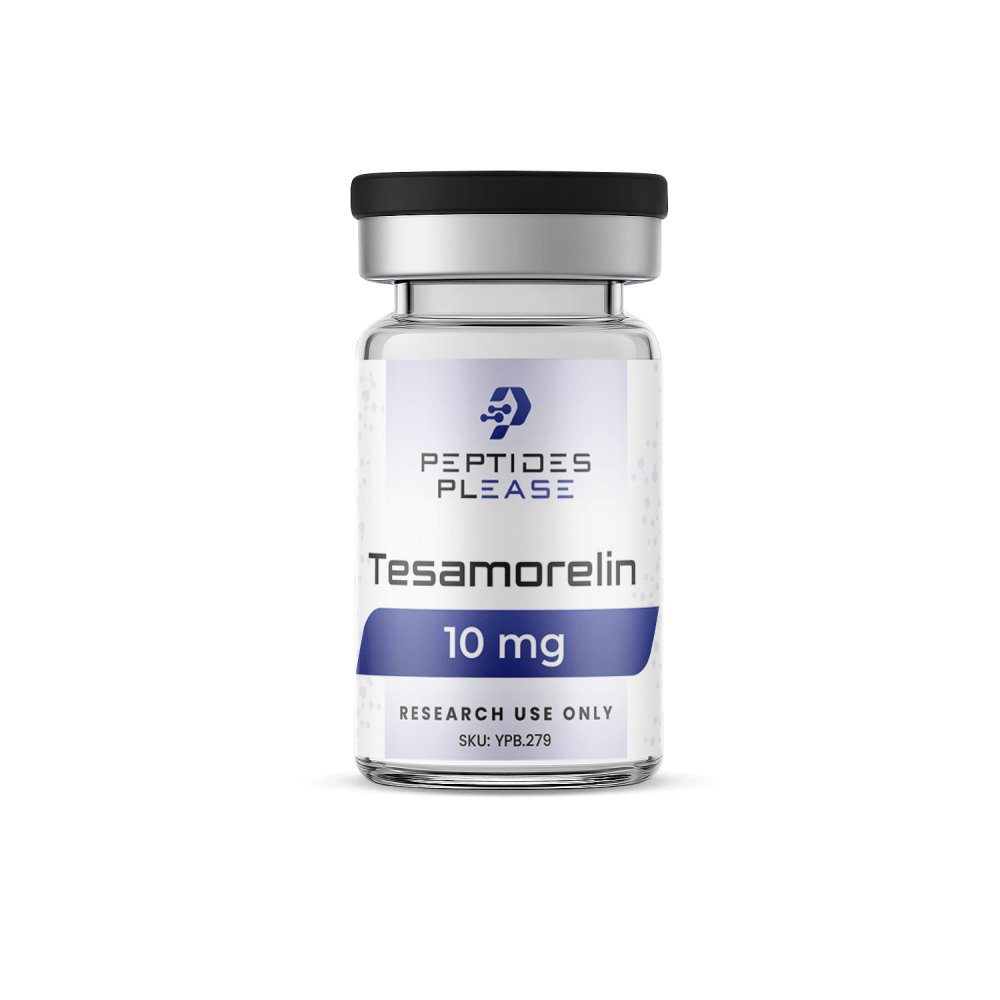 Popular PeptidesTesamorelin (10mg)
Tesamorelin is a synthetic analog of growth hormone-releasing factor (GHRF) studied for its effect on pituitary growth hormone secretion and visceral fat metabolism. Peptides Please supplies lyophilized, research-grade tesamorelin at ≥99% purity, verified by HPLC and mass spectrometry with a certificate of analysis on every batch. All material is sold strictly for laboratory research and is not for human or animal use.
Buy Tesamorelin 10mg for Research
What Is Tesamorelin?
Tesamorelin is a synthetic peptide built from the 44 amino acids of human growth hormone-releasing hormone (GHRH) with an added trans-3-hexenoic acid group that improves stability and potency over the native peptide. It binds pituitary GHRH receptors and signals the release of endogenous growth hormone, which in turn raises insulin-like growth factor 1 (IGF-1). In the published literature it has been studied for reductions in visceral adipose tissue and for metabolic endpoints such as liver fat in nonalcoholic fatty liver disease.
In research use, tesamorelin is handled as a laboratory reagent for in-vitro and scientific study of the GHRH and growth hormone pathway. It is not a consumer supplement and is not supplied for administration to humans or animals.
Is Tesamorelin FDA Approved?
The reference pharmaceutical form of tesamorelin is FDA approved. It is marketed as Egrifta, Egrifta SV and the newer Egrifta WR formulation, approved for the reduction of excess visceral abdominal fat in adults with HIV-associated lipodystrophy. That approval is specific to the finished prescription drug for that single indication. According to the Mayo Clinic, it is given by subcutaneous injection because the peptide would be broken down in the digestive tract.
The research-grade tesamorelin sold here is not the FDA-approved prescription product, is not a compounded medicine, and carries no approved human indication. Peptides Please is a research chemical supplier, not a compounding pharmacy or a 503A/503B outsourcing facility. The FDA status of the branded drug is provided only as factual regulatory background.
Tesamorelin Mechanism of Action
- Receptor binding: The modified 44-amino-acid sequence binds G-protein-coupled GHRH receptors on pituitary somatotroph cells, activating adenylyl cyclase and cAMP signaling that promotes growth hormone transcription and release.
- GH and IGF-1: Released growth hormone drives hepatic IGF-1 and IGFBP-3 production while preserving natural feedback loops, a point of research interest versus direct GH administration.
- Metabolic endpoints: Controlled studies have reported reductions in visceral adipose tissue over 26 weeks of use in the clinical population studied, alongside changes in triglycerides and body composition.
How to Reconstitute Tesamorelin in the Laboratory
Tesamorelin ships as a lyophilized (freeze-dried) powder because peptides are fragile and more stable in dry form. Reconstitution restores it to a liquid working solution for research. The widely used diluent for multi-use research vials is bacteriostatic water (0.9% benzyl alcohol), whose preservative inhibits microbial growth and supports a longer refrigerated working window than plain sterile water.
- Prepare a clean workspace. Disinfect the surface and wipe both the peptide vial stopper and the diluent vial with fresh alcohol swabs.
- Inspect the powder. Confirm an intact, cake-like lyophilized pellet and check expiry on the diluent before mixing.
- Add diluent slowly. Draw the planned volume of bacteriostatic water and run it down the inside glass wall of the vial rather than firing it directly onto the powder.
- Mix gently. Swirl in a slow circular motion until fully dissolved. Do not shake, as mechanical shear can denature the peptide and cause foaming.
- Verify clarity. A correctly reconstituted solution is clear and colorless with no visible particulates. Cloudiness or sediment indicates degradation.
Concentration math: adding more diluent raises total volume but never changes the fixed milligrams of peptide in the vial. A 10mg vial reconstituted with 2 mL yields 5 mg/mL; with 1 mL it yields 10 mg/mL. Choose the volume that gives a convenient working concentration for your assay.
Does Tesamorelin Need to Be Refrigerated?
Storage depends on state. As a dry lyophilized powder, tesamorelin tolerates short shipping periods at room temperature but is best held cold for the long term and kept away from light and freeze-thaw cycling. Once reconstituted, the working solution should be refrigerated at 2 to 8°C (36 to 46°F) and protected from light to preserve activity.
- Refrigerated working solution: reconstituted with bacteriostatic water, a research solution is typically held at 2 to 8°C and used within roughly 28 days before potency loss becomes a concern.
- Avoid freezing the solution: repeated freeze-thaw cycles degrade peptide structure. Do not freeze a reconstituted vial.
- Formulation note: storage rules for the branded prescription kits differ by formulation, which is why published consumer guidance appears to conflict. For research powder reconstituted in-house, cold storage of the mixed solution is the reliable default. See the Drugs.com monograph for the branded-product handling detail.
Handling and Stability Notes for Research Use
Because tesamorelin is delivered by injection in the clinical setting, the molecule is not stable in the digestive tract, which is why oral research formats are not used. In the lab, keep reconstituted material cold, minimize light exposure, label the vial with the reconstitution date, and discard any solution that turns cloudy. These handling habits protect data integrity across longer study windows. Documented effects of interest in the literature include elevated IGF-1 and changes in glucose parameters, which is why glucose-related readouts are commonly monitored in study designs.
Peptides Please ships research-grade tesamorelin and reconstitution supplies to laboratories across the USA and Canada, with a certificate of analysis included for each lot.
Tesamorelin Price
Research-grade Tesamorelin (10mg) is priced at $150 per vial, supplied as a sterile lyophilized powder with batch COA. Pair it with reconstitution water to prepare your working solution.
Related Research Peptides
Researchers studying the growth hormone pathway often compare tesamorelin alongside other secretagogues. Browse CJC-1295, Ipamorelin, and GHRP-6 Acetate for adjacent lines of study.
Frequently Asked Questions
Is tesamorelin FDA approved?
The branded prescription drug (Egrifta, Egrifta SV, Egrifta WR) is FDA approved for reducing excess visceral abdominal fat in adults with HIV-associated lipodystrophy. The research-grade powder sold here is not that approved product and has no approved human use.
How do you reconstitute a 10mg vial of tesamorelin?
Add bacteriostatic water down the vial wall and swirl gently until clear. Two milliliters gives a 5 mg/mL solution; one milliliter gives 10 mg/mL. Never shake.
Does tesamorelin need to be refrigerated after reconstitution?
Yes. Hold the mixed solution at 2 to 8°C, protected from light, and use it within about 28 days. Do not freeze it.
Can tesamorelin powder sit at room temperature?
The dry lyophilized powder tolerates brief room-temperature shipping, but cold storage away from light and freeze-thaw cycling is best for long-term stability.
Is tesamorelin taken orally?
No. The peptide is broken down in the digestive tract, so research handling uses the reconstituted solution, not an oral format.
Buy Research Tesamorelin at Peptides Please
Every vial of tesamorelin is manufactured to ≥99% purity, third-party tested, and shipped with a certificate of analysis. All products are for research use only and are not for human or animal consumption.