SLU PP 332
Showing the single result
-
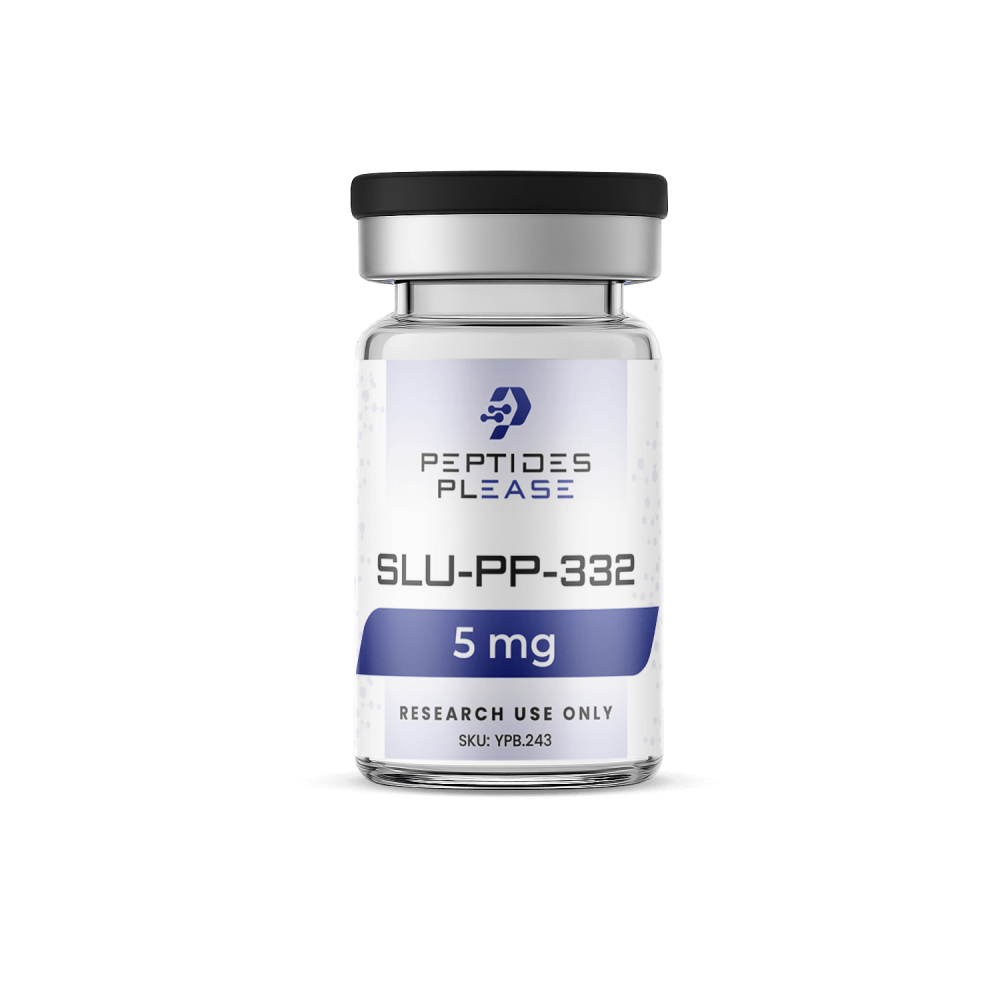 SLU PP 332SLU-PP-332 (5mg)
SLU-PP-332 is a potent, non-selective agonist of the estrogen-related receptors (ERRs), primarily targeting ERRα with an EC50 of 98 nM, and it modulates mitochondrial function and energy metabolism. Often described as an “exercise mimetic,” this synthetic small molecule activates metabolic pathways similar to those triggered by endurance training, supporting fat oxidation, glucose utilization, thermogenesis, and cellular respiration in preclinical models. All SLU-PP-332 sold here is a research-grade compound for laboratory use only and is not for human or animal consumption.
Buy SLU-PP-332 Peptide for Research at Peptides Please
Researchers can source high-purity SLU-PP-332 (5mg) at Peptides Please, a trusted supplier of research-grade compounds with independent third-party testing, lyophilized storage guidance, and competitive pricing for in-vitro and preclinical metabolic studies. Peptides Please ships to the USA and Canada, and every compound is supplied strictly for research use only.
What Is SLU-PP-332?
SLU-PP-332 is a potent estrogen-related receptor (ERR) agonist that has emerged in preclinical research on metabolic disorders, particularly obesity models. In obese mice, administration reduced body weight and fat-mass accumulation by increasing fatty-acid oxidation and improving fatty-acid metabolism. These effects stem from activation of ERRα, a key regulator of energy homeostasis that drives mitochondrial function and lipid utilization in peripheral tissues.
Beyond fat metabolism, SLU-PP-332 has shown effects on skeletal muscle in rodent studies, increasing muscle mass and function without an exercise stimulus by upregulating genes tied to oxidative metabolism. This dual action on fat and muscle has made it a compound of interest for research into obesity-related sarcopenia and body-composition science. For background, see the SLU-PP-332 overview.
SLU-PP-332 Mechanism of Action
SLU-PP-332 is an exercise-mimetic ERR agonist whose mechanism centers on activating estrogen-related receptors, primarily ERRα, in metabolically active tissues, driving a transcriptional program that increases mitochondrial biogenesis, oxidative metabolism, and fat utilization.
Core receptor-level mechanism
- SLU-PP-332 is a potent agonist of the estrogen-related receptor family (ERRα greater than other ERRs), binding the ligand-binding domain and stabilizing the receptor’s active conformation.
- Activated ERRα recruits co-activators, especially PGC-1α, forming a transcriptional complex that binds estrogen-related response elements (ERREs) on DNA.
- This complex upregulates large sets of exercise-responsive genes involved in mitochondrial function, oxidative phosphorylation, and substrate handling.
Downstream molecular effects
- Mitochondrial biogenesis and function: increased PGC-1α and mitochondrial genes promote higher mitochondrial content and oxidative capacity in skeletal muscle and other high-demand tissues.
- Substrate utilization: upregulation of fatty-acid oxidation enzymes and uncoupling proteins shifts metabolism toward fat oxidation and thermogenesis, raising energy expenditure.
- Glucose handling: elevated GLUT4 and related transporters improve glucose uptake and insulin sensitivity in metabolically active tissues.
Tissue-level outcomes (preclinical)
- In rodent models, SLU-PP-332 behaves as an exercise mimetic, promoting a more oxidative muscle phenotype, improving endurance, and counteracting features of metabolic syndrome, including diet-induced obesity.
- It raises whole-body energy expenditure and restrains weight gain without reducing appetite, consistent with an effect on mitochondrial efficiency and substrate oxidation rather than caloric intake.
SLU-PP-332 Benefits (Preclinical Research)
Metabolic and fat-loss findings
In animal models, SLU-PP-332 increased fatty-acid oxidation, reduced fat-mass accumulation, and limited diet-induced weight gain, which is why it is studied as a metabolic-syndrome and obesity research compound.
Performance and muscle findings
Rodent data show improved endurance and a shift toward an oxidative muscle phenotype without an exercise stimulus, supporting its “exercise-mimetic” description.
Organ and metabolic-health findings
Research has explored effects on glucose handling, insulin sensitivity, and fatty-liver endpoints driven by ERR-regulated gene expression such as PGC-1α and PDK4.
How SLU-PP-332 Is Handled and Prepared in Research Settings
SLU-PP-332 is a synthetic small molecule rather than a true peptide, but it is typically handled within a standard research-peptide workflow so laboratory procedures stay consistent. The guidance below covers handling, reconstitution, and preparation for in-vitro and preclinical work only. It is not instruction for human or animal use.
- Classification awareness: treat SLU-PP-332 as a small-molecule research chemical and document it as such in your protocol.
- Precise measurement: use calibrated laboratory micro-scales so the exact mass is recorded and experimental concentrations stay reproducible.
- Concentration control: the ERR pathway is sensitive to small concentration changes, so calculated working concentrations should be followed closely to keep metabolic readouts comparable.
- Consistency across cohorts: apply the same prepared volume to every sample in a group to prevent skewed data and preserve statistical power.
- Rigorous handling: protect the compound from contamination and degradation to maintain integrity across longer mitochondrial-biogenesis studies.
Reconstitution and solution handling
- Solubility verification: confirm the compound is fully dissolved in the chosen solvent before use so the active ERR agonist is uniformly distributed.
- Precipitation check: inspect the vial for any settled material that could cause inconsistent working concentrations.
- Homogenization: gently swirl before drawing each aliquot to avoid concentration gradients.
- Precision tools: use a graduated pipette or micro-syringe to measure exact microliter volumes and hold the tolerances peer-reviewed work requires.
Lyophilized powder and storage
SLU-PP-332 is typically supplied lyophilized. Store the sealed powder cold and protected from light, reconstitute only the amount a protocol needs, and keep reconstituted solution refrigerated for the short window your laboratory’s stability guidance allows. Always reconstitute with an appropriate research solvent such as bacteriostatic or sterile water per your protocol.
SLU-PP-332 Routes Studied and Timing (Research Context)
In published preclinical work, SLU-PP-332 has been administered by injection in rodent models; oral and other routes appear only in community reports, not controlled human data. Timing, food state, and pairing with exercise are experimental variables a study design should fix in advance so results stay comparable. None of this constitutes a human-use protocol.
SLU-PP-332 Side Effects
Because SLU-PP-332 has not been tested in humans, there is no established human safety or side-effect profile. Reported observations come only from cell and animal studies, where the compound’s short half-life is one reason researchers study repeated administration. Any safety conclusion outside those models is extrapolation.
SLU-PP-332 Clinical Trials
Human trials
As of 2026 there are no completed or registered human clinical trials of SLU-PP-332, no FDA label, and no human pharmacokinetic data. The evidence base is entirely preclinical, which is the single most important fact for anyone evaluating this compound. See the published summary of its research status.
SLU-PP-332 Price
SLU-PP-332 (5mg) is listed at $110 per vial on the product page, supplied at research-grade purity with third-party testing. For related metabolic research compounds, researchers also compare 5-Amino-1MQ, Cagrilintide, and Mazdutide.
Research SLU-PP-332 for Sale at Peptides Please
Order SLU-PP-332 (5mg) for your next metabolic study. Every vial is for research use only and is not for human or animal consumption.
Frequently Asked Questions
What is SLU-PP-332 used for?
It is a research compound used to study ERRα activation, mitochondrial biogenesis, fat oxidation, and metabolic-syndrome endpoints in cell and animal models.
What is another name for SLU-PP-332?
It is referred to simply as SLU-PP-332 or as an ERR agonist / “exercise mimetic.” It has no approved drug name because it has not reached human clinical use.
Is SLU-PP-332 a peptide?
No. It is a synthetic small molecule, though it is often grouped with research peptides for handling and sourcing purposes.
Is there a validated human dose for SLU-PP-332?
No. No human clinical trial has administered SLU-PP-332, so no validated human dose exists. Any figure circulating online is extrapolation, not evidence, and this product is supplied for laboratory research only.
In which routes has SLU-PP-332 been studied?
Published preclinical studies used injectable administration in rodents. It is handled in the lab by reconstituting the lyophilized powder with an appropriate research solvent.
What are the side effects of SLU-PP-332?
There is no established human side-effect profile because it has only been studied in cell and animal models.