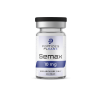
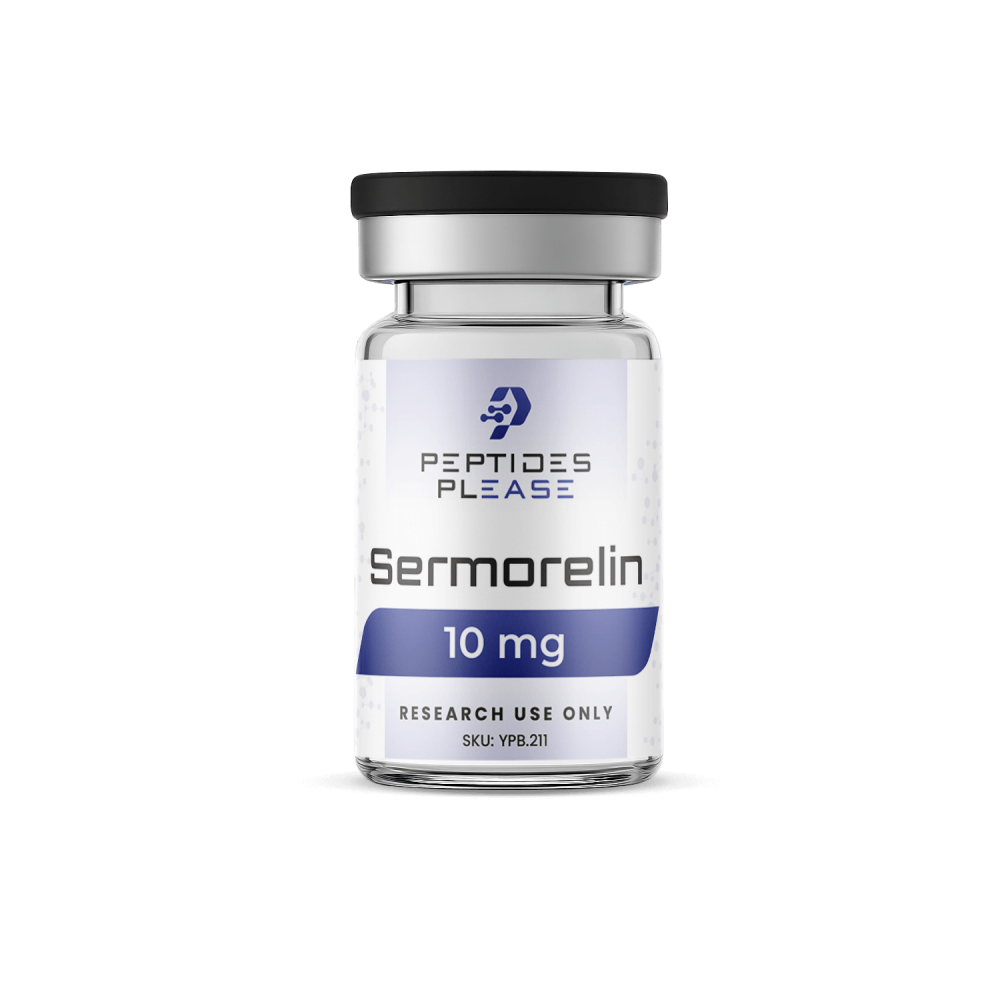
Sermorelin (10mg)
$100.00
In stock
Third-party tested
COA included
GMP certified
30-day guarantee
Certificate of Analysis available for this product. Independent third-party testing confirms identity, purity, and absence of contaminants.
Download COA →
Sermorelin (10mg) Interactive 3D Molecular Model
Drag to rotate · Enable "Zoom on scroll" to zoom
Amino Acid Sequence
Non-polar, aliphatic
Neutral
75.03 Da
pKa α-NH₂ 9.60 · α-COOH 2.34
The smallest amino acid — its lack of sidechain grants exceptional backbone flexibility. Essential for tight protein turns and collagen's Gly-X-Y triplet repeat. In peptide research, glycine residues are used as spacers and to reduce steric bulk.
Frequently incorporated into peptide scaffolds to improve solubility and conformational freedom. GHRP-2 and GHRP-6, potent GH secretagogues used in research, both contain Gly residues critical to receptor binding.
Non-polar, aliphatic
Neutral
89.09 Da
pKa α-NH₂ 9.69 · α-COOH 2.34
The second simplest amino acid, alanine's methyl sidechain contributes to hydrophobic core stability without introducing much steric strain. It is the most abundant residue in helical segments of proteins.
Alanine-scanning mutagenesis is a cornerstone technique in peptide engineering: replacing each residue with Ala reveals which positions are critical for bioactivity. Common in research peptides such as Selank and Semax analogues.
Non-polar, aliphatic
Neutral
117.15 Da
pKa α-NH₂ 9.62 · α-COOH 2.32
Branched-chain amino acid (BCAA) with a β-branched isopropyl sidechain that promotes β-sheet formation and hydrophobic packing. Abundant in transmembrane helices.
BCAAs including Val are studied for anabolic signaling via mTOR. Val residues in IGF-1 LR3 and other growth factor analogues contribute to structural stability and receptor recognition.
Non-polar, aliphatic
Neutral
131.17 Da
pKa α-NH₂ 9.60 · α-COOH 2.36
The most common BCAA in proteins, leucine drives hydrophobic core formation and is the strongest activator of the mTOR/S6K1 anabolic pathway among all amino acids.
Leucine-rich peptide sequences are found in GH-releasing peptides (GHRH analogues). CJC-1295 and Ipamorelin contain Leu residues that anchor binding in the pituitary receptor pocket, driving GH pulse amplitude in preclinical studies.
Non-polar, aliphatic
Neutral
131.17 Da
pKa α-NH₂ 9.68 · α-COOH 2.36
Isoleucine is a β-branched BCAA that strongly favors β-sheet conformation and resists helix formation. It stabilizes hydrophobic interfaces in peptide dimers and coiled-coils.
Ile is a key pharmacophore in melanocortin peptides like Melanotan II, where its sidechain makes critical van der Waals contacts with the MC1R/MC4R binding pocket, modulating eumelanin synthesis and studied for pigmentation and metabolic research.
Non-polar, cyclic
Neutral
115.13 Da
pKa α-NH₂ 10.60 · α-COOH 1.99
The only cyclic proteinogenic amino acid. Its pyrrolidine ring constrains the backbone φ angle, breaking helices and introducing rigid turns. Collagen triple-helix stability depends heavily on the Gly-Pro-Hyp triplet.
Proline substitutions are used to lock peptides into bioactive conformations, improving receptor selectivity and proteolytic resistance. BPC-157 contains a Pro residue critical to its stability and regenerative signaling in preclinical wound-healing models.
Non-polar, aromatic
Neutral
165.19 Da
pKa α-NH₂ 9.13 · α-COOH 1.83
Phenylalanine's benzyl sidechain contributes strong hydrophobic and π-stacking interactions. It is among the most helix-favoring and rigidifying aromatic residues.
Phe is the central pharmacophore in enkephalins and many synthetic opioid peptides. In Ipamorelin (Aib-His-D-2-Nal-D-Phe-Lys-NH₂), D-Phe at position 4 is the primary contact for ghrelin receptor activation, studied in growth hormone research.
Non-polar, aromatic
Neutral
204.23 Da
pKa α-NH₂ 9.39 · α-COOH 2.38
The largest and most complex standard amino acid, tryptophan's indole ring participates in cation-π and π-stacking interactions. It acts as an intrinsic fluorescent probe for protein folding studies.
Trp and its D-isomer appear in numerous bioactive peptides. Semax (Met-Glu-His-Phe-Pro-Gly-Pro) contains a Phe-Pro pharmacophore related to ACTH, and Trp analogues are explored in BDNF-mimetic peptide design for neuroprotection research.
Non-polar, sulfur-containing
Neutral
149.21 Da
pKa α-NH₂ 9.21 · α-COOH 2.28
Methionine serves as the universal translation start codon (Met-tRNA). Its thioether sidechain participates in hydrophobic packing and is susceptible to oxidation, a key consideration in peptide formulation.
Met-enkephalin (Tyr-Gly-Gly-Phe-Met) is the archetypical endogenous opioid. Oxidation of Met during storage reduces peptide potency; researchers use norleucine substitutions or lyophilization under inert atmosphere to preserve activity.
Polar, uncharged
Neutral
105.09 Da
pKa α-NH₂ 9.15 · α-COOH 2.21
Serine's hydroxyl group participates in hydrogen bonding and is the principal site of O-linked glycosylation and phosphorylation in signaling cascades (Ser/Thr kinases).
Phospho-Ser residues are used in research to mimic constitutively phosphorylated signaling states. Ser residues in TB-500 (Thymosin β4) and LL-37 antimicrobial peptides contribute to aqueous solubility critical for in vitro assays.
Polar, uncharged
Neutral
119.12 Da
pKa α-NH₂ 9.10 · α-COOH 2.09
Threonine is the only β-hydroxyl amino acid with a chiral β-carbon. Its hydroxyl supports hydrogen bonding and O-GalNAc mucin-type glycosylation, and Ser/Thr sites are the primary substrates for PKA, PKC, and CaMKII.
Thr is a key residue in the hinge region of IGF-1 and in GLP-1 analogues studied for metabolic regulation. Phospho-Thr peptides serve as tool compounds for kinase inhibitor development.
Polar, uncharged (sulfur)
Neutral
121.16 Da
pKa α-NH₂ 10.78 · α-COOH 1.71 · thiol 8.18
Cysteine's thiol sidechain undergoes reversible oxidation to form disulfide bonds (–S–S–) that critically stabilize protein tertiary structure. It also acts as a nucleophile in enzyme active sites.
Disulfide-cyclized peptides exhibit dramatically improved proteolytic stability and receptor selectivity. α-Conotoxins, ω-conotoxins (ziconotide), and oxytocin all depend on Cys–Cys bridges. Site-directed PEGylation via Cys thiols extends peptide half-life in research models.
Polar, aromatic
Neutral (ionizable at high pH)
181.19 Da
pKa α-NH₂ 9.11 · α-COOH 2.20 · phenol 10.07
Tyrosine combines aromatic hydrophobicity with a polar phenol capable of hydrogen bonding and phosphorylation. It is the substrate for Tyr kinases (RTKs, Src family) and is iodinated in thyroid hormone (T3/T4) biosynthesis.
Tyr is the N-terminal residue of all endogenous opioid peptides and is essential for μ-opioid receptor activation. In Melanotan II (Ac-Nle-c[Asp-His-D-Phe-Arg-Trp-Lys]-NH₂), Tyr analogues modulate MC4R binding and are studied in melanocortin receptor pharmacology.
Polar, uncharged
Neutral
132.12 Da
pKa α-NH₂ 8.80 · α-COOH 2.02
Asparagine's amide sidechain forms hydrogen bonds and is the canonical site of N-linked glycosylation (Asn-X-Ser/Thr sequon). It also undergoes spontaneous deamidation to Asp, a key degradation pathway in therapeutic peptides.
Asn deamidation is a primary stability concern in peptide drug development. Substituting Asn with Asp or using iso-Asn analogues is explored to improve shelf life. Asn residues in GHRH(1-29) are important for GH secretagogue activity.
Polar, uncharged
Neutral
146.15 Da
pKa α-NH₂ 9.13 · α-COOH 2.17
Glutamine is the most abundant free amino acid in plasma, a major nitrogen shuttle between tissues, and the primary fuel for rapidly dividing cells (glutaminolysis). Its amide sidechain participates in receptor recognition and hydrogen bonding.
Gln-containing peptides are studied in gut-permeability and mucosal integrity research. Glutamine is the C-terminal residue in many GHRH analogues; its amide form (Gln vs. Glu) dramatically affects GH-releasing potency and pituitary receptor binding.
Polar, negatively charged
Negative (pH 7)
133.10 Da
pKa α-NH₂ 9.60 · α-COOH 1.88 · sidechain 3.65
Aspartate is a key excitatory neurotransmitter precursor and participates in the urea cycle. Its carboxylate coordinates metal ions (Asp-His-His Zn²⁺ triads in metalloproteases) and forms salt bridges essential to protein stability.
Asp residues in lactam-bridged GHRH analogues (c[Asp-Lys] bridges) constrain helix conformation, increasing GH-releasing potency up to 1000-fold versus linear peptides in animal models. Also critical in integrin-binding RGD (Arg-Gly-Asp) motifs studied for tissue engineering scaffolds.
Polar, negatively charged
Negative (pH 7)
147.13 Da
pKa α-NH₂ 9.47 · α-COOH 2.10 · sidechain 4.07
Glutamate is the principal excitatory neurotransmitter in the CNS and a key hub of central carbon metabolism (TCA cycle via α-ketoglutarate). Its longer sidechain carboxylate favors α-helix formation via intrachain salt bridges.
Fatty-acid conjugation at Glu sidechains (as in semaglutide/liraglutide) extends plasma half-life by promoting albumin binding. This Glu-acylation strategy is widely studied for creating long-acting GLP-1, GIP, and GH research analogues.
Polar, positively charged
Positive (pH 7)
146.19 Da
pKa α-NH₂ 9.18 · α-COOH 2.16 · ε-NH₂ 10.53
Lysine's ε-amino group is the primary site of ubiquitination, acetylation (histones), and chemical conjugation. It confers positive charge that drives binding to negatively charged membrane phospholipids and DNA.
Lys is the key conjugation handle in peptide–drug conjugates (PDCs), PEGylated peptides, and lipopeptides. In CJC-1295 (DAC-GHRH), Lys is the reactive site for Drug Affinity Complex technology that covalently binds serum albumin, extending half-life to ~8 days in primates.
Polar, positively charged
Positive (pH 7)
174.20 Da
pKa α-NH₂ 9.04 · α-COOH 2.18 · guanidinium 12.48
Arginine's guanidinium group maintains positive charge across the full physiological pH range. It drives cell-penetrating peptide (CPP) internalization, anchors peptides to heparan sulfate proteoglycans, and is a key substrate of nitric oxide synthase (→ NO).
Poly-Arg CPPs (e.g., R9) are widely used to deliver research peptides intracellularly. Arg residues in BPC-157 and Epithalon are important for angiogenic and telomerase-activating effects studied in preclinical longevity research.
Polar, positively charged (ionizable)
Neutral/Positive (pKa ~6)
155.16 Da
pKa α-NH₂ 9.17 · α-COOH 1.82 · imidazole 6.00
Histidine's imidazole ring (pKa ~6) acts as a pH-sensitive proton shuttle — uniquely positioned between protonated and neutral at physiological pH. It is the catalytic acid/base in serine proteases, carbonic anhydrase, and numerous metalloenzymes.
His is found in most GH-releasing peptides: GHRP-2 (D-Ala-D-β-Nal-Ala-Trp-D-Phe-Lys), Ipamorelin, Hexarelin all contain His essential for GHSR-1a binding. Its Zn²⁺-chelating ability is exploited in His-tag purification of research peptide constructs.