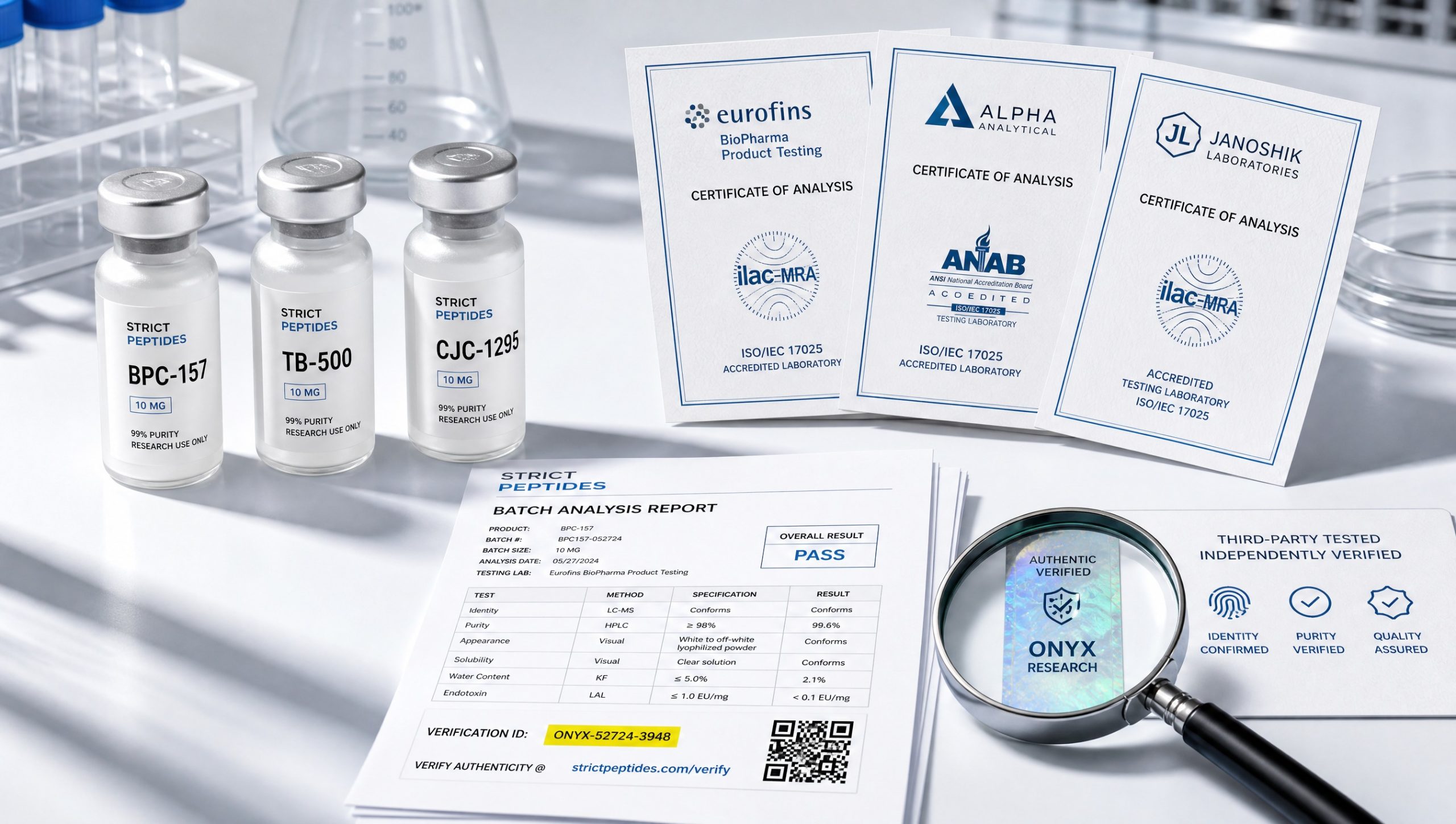
If you are searching whether Onyx Research Peptides is third party tested, you are asking exactly the right question, because a research compound is only usable when an independent lab has confirmed its identity and purity for the batch you actually receive. That instinct matches what analytical chemists and quality-focused suppliers already agree on: never take a testing claim on trust. The problem is that a brand-name search cannot settle it, because the phrase “third-party tested” printed on a product page is marketing text, not evidence. The evidence is a named lab report tied to a lot number you can trace. This guide shows you who runs independent peptide testing, what separates a real report from a decorative one, and how to trace any vendor’s claim back to a lab, and if you would rather start with compounds that publish their documentation you can open the research peptide catalogue and check each listing against the tests below.
Here is the part a brand-name search will not give you. There is now a large, active, independent testing ecosystem for consumer and research peptides, and its own verification systems are built around single batches, not brand-wide certificates. That structural fact is the key to reading any “third-party tested” claim correctly, and the market data and method below are how you use it.
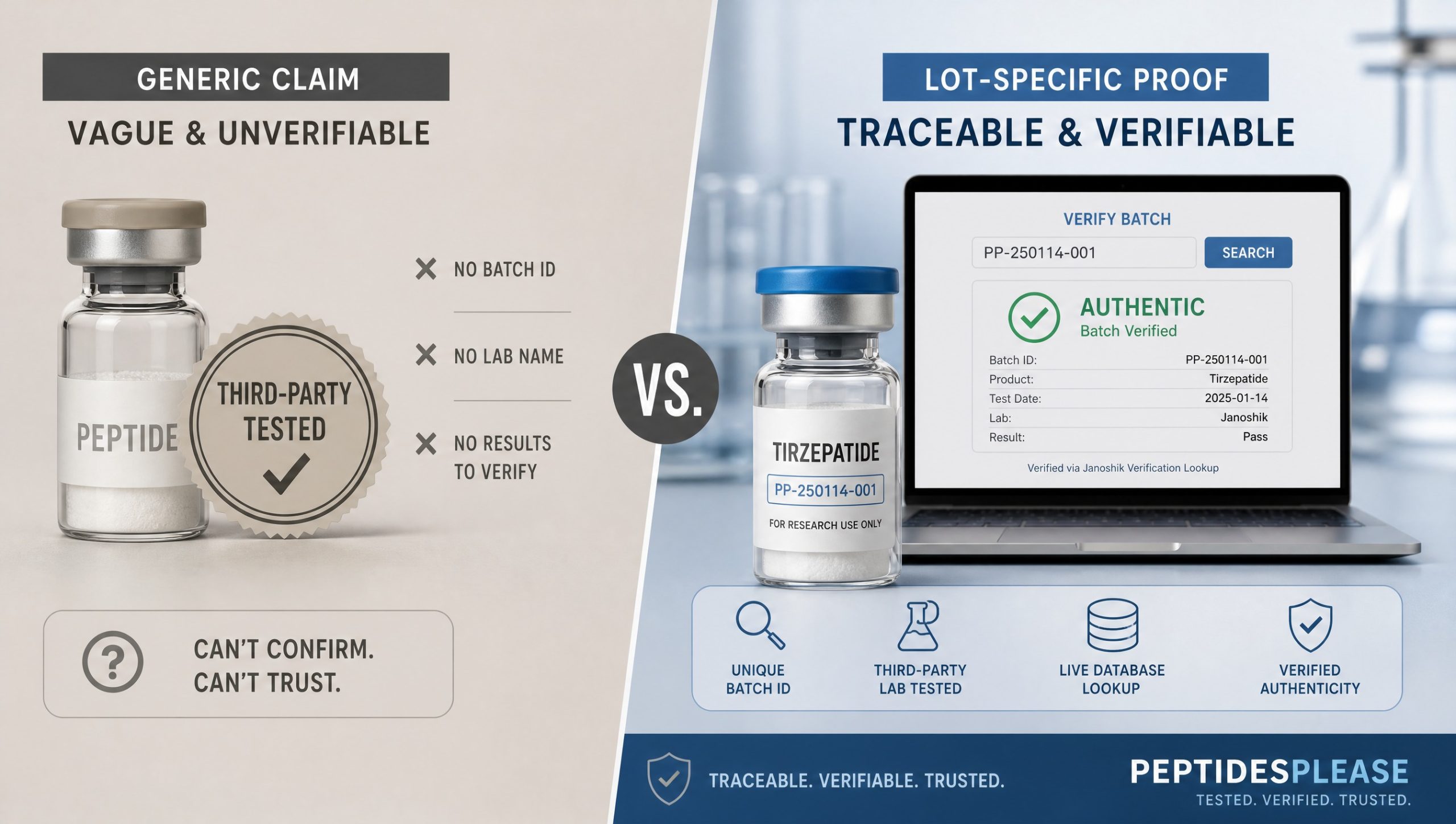 How a verifiable batch ID proves third-party testing, versus a vague brand-wide claim.
Key Takeaways
- No brand-name search confirms third-party testing. Only a batch-specific certificate of analysis (COA) from a named independent lab, pairing HPLC purity with mass spectrometry identity, can.
- Independent peptide-testing labs verify one lot at a time. One public database, Finnrick, had logged over 9,500 individual peptide tests as of August 2026, each tied to a unique checkable ID.
- “Third-party tested” is a spectrum, not a yes or no. The strong version names an accredited lab (ISO/IEC 17025), covers your specific batch, and shows both purity and identity.
- Independent testing has repeatedly found consumer peptides far below their labels: a 2024 peer-reviewed study measured vials labeled 99 percent at 7.7 to 14.37 percent actual purity.
- Peptides Please is a research chemical supplier and is not a compounding pharmacy or an outsourcing facility under 503A or 503B of the Federal Food, Drug, and Cosmetic Act; all products are for laboratory and in-vitro research only.
What “Third-Party Tested” Really Means, and Why a Brand Name Cannot Answer It
Third-party tested means an independent laboratory with no financial stake in the result, not the seller’s own team, measured the compound and issued a certificate tied to a specific batch. That is the definition quality sources agree on, and it is the correct one. The value is the removal of conflict of interest: an outside lab reporting 96.4 percent purity on a named lot is a far stronger signal than a banner reading “high purity.” In-house testing still has a role for a manufacturer’s process control, but only independent data tells you, the buyer, that the vial in front of you matches its label. The reason a brand name cannot answer the question is that testing happens at the level of the lot, not the label. Independent labs issue reports per production batch, so a company can be truthfully “third-party tested” on one batch and still ship you a later, untested lot from the same catalogue. A legitimate contract-scale manufacturer states plainly that “the HPLC-purity of most of our peptides is 95% or above,” a benchmark published in the technical FAQ of the Swiss GMP supplier Bachem, which sets a realistic reference for what real analytical purity looks like. A brand claim collapses batch, method, and identity into one word. A lot-specific COA keeps them separate, which is the entire point of asking for one. Browse Third-Party Tested Research PeptidesWho Actually Runs Independent Peptide Testing
Independent peptide testing is done by a small set of specialist analytical labs, and knowing their names is the fastest way to judge whether a “third-party” claim points at anything real. These labs accept vials from vendors and individual researchers, run the analysis, and publish results the buyer can look up rather than take on faith. One of them, Finnrick, had logged more than 9,500 individual peptide tests in its public database as of August 2026, a running counter you can see on the Finnrick testing service homepage. That same database breaks the work out by compound, listing over 100 separate vendors tested for BPC-157 alone, which is the clearest signal that this is a real, ongoing ecosystem and not a handful of showcase samples. The structural detail that matters is how these labs verify their own work. Janoshik Analytical, one of the most cited names in the space, issues each certificate with a unique key that you enter on its own COA verification tool to confirm the report is genuine and unaltered. Finnrick runs a comparable public lookup. Both systems are built around a single tested batch carrying a checkable ID, not a brand-wide seal, which is exactly why a vendor advertising “third-party tested” without a lot-specific, publicly verifiable number is making a claim their own testing lab’s system is designed to expose. When you evaluate a compound like BPC-157, the right question is not “is this brand tested” but “can I look up the report for this lot on the lab’s own site.”
How a verifiable batch ID proves third-party testing, versus a vague brand-wide claim.
“Third-Party Tested” Is a Spectrum, Not a Yes or No
The phrase covers a wide range of rigor, so treating it as a single yes-or-no box is the most common mistake buyers make. A weak version is one old report on one flattering batch; a strong version is a current, lot-matched report from a named, accredited lab showing both purity and identity. The single best accreditation signal is ISO/IEC 17025, whose current 2017 edition is the international standard for the competence and impartiality of testing laboratories, published by the International Organization for Standardization. A report from a lab holding that accreditation carries far more weight than one from an unnamed “independent lab” you cannot identify. Four attributes separate the strong end of the spectrum from the decorative end, and a claim needs all four to be worth anything.- Independence. The lab has no commercial stake in the result. An in-house number reported by the seller is process control, not verification.
- A named, ideally accredited lab. “Third-party tested” with no lab named is a blank where the most important fact should be. A named lab, better still one you can confirm holds ISO/IEC 17025, is checkable.
- Batch specificity. The report’s lot number must match the vial you receive. A single static COA reused across every order and every restock verifies nothing about your material.
- Purity and identity together. HPLC answers how pure the sample is; mass spectrometry answers whether the pure thing is the right thing. A number without a chromatogram, or a purity figure with no identity confirmation, is half a test.
What Independent Labs Found When They Tested the Market
Independent testing of the consumer peptide market has repeatedly turned up products that do not match their labels, and that record is the empirical reason to verify rather than trust. The strongest single dataset is a 2024 peer-reviewed study in the Journal of Medical Internet Research, which bought injectable vials from illegal online sellers and found that three samples, all labeled roughly 99 percent purity, measured 14.37 percent, 7.70 percent, and 8.97 percent actual purity, with detectable endotoxin in every one, as reported in the JMIR analysis of unapproved online products. That same study found labeling or packaging noncompliance across 59 to 63 percent of the regulatory criteria it evaluated. The pattern is not confined to one study. Independent lab testing summarized in 2026 reporting covered nearly 450 samples of BPC-157 sourced from 64 vendors, and among the vials that actually contained the compound, measured purity ranged from about 82 to 100 percent, while some vials sold as BPC-157 contained none of it at all, according to MIT Technology Review’s reporting on peptide quality. That same reporting noted that 8 percent of all the peptide samples the lab tested showed measurable endotoxin. The takeaway is not that testing is rare, it is that quality varies by vendor and by batch, so a brand being tested once is not proof your lot was tested. Comparing documentation across a shortlist, the way you might when weighing options in a roundup like the most popular research peptides of 2025, beats trusting any single brand claim.The One Check That Settles It: Trace the Report to Your Lot
You do not have to guess whether a vendor is third party tested, because one check settles it: trace the report back to a named lab and forward to your specific lot. Run it in that order and the marketing phrase becomes irrelevant. First, find the lab. A genuine report names the issuing laboratory and, on the strongest reports, carries a verification key or reference number you look up on the lab’s own domain, such as the Janoshik verification tool. If the “COA” is only a flat image hosted on the seller’s site with no way to trace it to a lab, treat it as decoration. Second, match the lot. Ask for the current certificate for the exact lot the vendor would ship you, and confirm the lot number on that certificate matches the number on the vial you receive. A production lot is a separate test, so a two-year-old generic PDF is not batch verification. Third, if you want your own data rather than anyone’s word, independent labs accept researcher-submitted samples and will run HPLC purity and mass-spec identity for a modest fee. Sending one vial out converts a vendor’s claim into a result you commissioned. See Our Full Research Peptide CatalogueWhere Third-Party Testing Stops and Regulation Begins
Third-party testing is a quality control step, not a regulatory approval, and keeping that line clear protects you from over-reading even a clean report. Under United States current good manufacturing practice rules, a facility must keep “complete data derived from all tests necessary to assure compliance with established specifications and standards,” the traceability requirement codified at 21 CFR 211.194, which is the legal backbone of what a real COA represents. Enforcement in the bulk-peptide supply chain is active: the FDA issued a warning letter in April 2026 to a China-based bulk peptide ingredient manufacturer citing good-manufacturing-practice deviations, documented in the agency’s warning letter records. A COA speaks to the analytical quality of one batch. It does not speak to safety for any use, which is why most research compounds sit outside the formal US regulatory approval system. That distinction is the reason the supplier’s own status matters. Peptides Please is a research chemical supplier and is not a compounding pharmacy or an outsourcing facility under 503A or 503B of the Federal Food, Drug, and Cosmetic Act, and every product is supplied for laboratory and in-vitro research only, not for human or animal use. Publishing analytical data supports valid research; it is not an invitation to consumption. The same care extends downstream to handling, such as using the correct reconstitution water so a verified peptide is not degraded after it arrives, and to reading broader context on what the evidence does and does not show, such as our discussion of whether peptides are safe in the research settings where they are studied.Frequently Asked Questions
Is Onyx Research Peptides third party tested?
No brand-name search can confirm that, including this one. Third-party testing is verified by a batch-specific certificate of analysis from a named independent laboratory, showing HPLC purity and mass spectrometry identity for the exact lot you would receive, not by a claim printed on a product page. Request the lot-matched COA before buying, confirm it traces to a named lab, and, if you want certainty, submit a vial to an independent lab yourself.Who actually does independent peptide testing?
A small set of specialist analytical labs, such as Janoshik Analytical and Finnrick, test research peptides submitted by vendors and individual researchers and publish results you can look up. They run HPLC for purity and mass spectrometry for identity, and they issue reports per batch with a unique verification key. Finnrick’s public database had logged over 9,500 individual peptide tests as of August 2026.What is ISO/IEC 17025 and why does it matter for testing?
ISO/IEC 17025 is the international standard for the competence and impartiality of testing and calibration laboratories, with the current edition published in 2017. A report from a lab holding that accreditation carries more weight because the lab’s methods and quality systems have been independently assessed. When a vendor names an accredited lab rather than a vague “independent lab,” the testing claim is far easier to trust.Can a brand be “third-party tested” and still ship an untested vial?
Yes. Independent labs test one production batch at a time, so a company can hold a genuine report on one lot and still ship a later lot that was never independently tested. This is why a brand-wide claim is weaker than a lot-matched certificate. Always confirm the lot number on the COA matches the number on the vial you receive.What did lab testing actually find in the peptide market?
A 2024 peer-reviewed study found vials labeled roughly 99 percent purity that measured 7.7 to 14.37 percent actual purity, with endotoxin in every sample. Separate 2026 reporting on nearly 450 BPC-157 samples from 64 vendors found purity ranging from about 82 to 100 percent among vials that contained the compound, with some containing none of it. This is the empirical reason to verify rather than trust a label.Does third-party testing mean a peptide is safe to use?
No. Third-party testing verifies purity and identity for research purposes only; it does not establish safety for human or animal use. Research peptides are supplied for laboratory and in-vitro study, and a certificate of analysis reports analytical quality, not clinical safety. The research-use-only framing holds regardless of how clean a test result looks.Does Onyx Research provide third-party HPLC and MS testing for its peptides?
Yes, Onyx Research provides High-Performance Liquid Chromatography (HPLC) and Mass Spectrometry (MS) certificates of analysis (COA) to verify peptide purity and sequence identity.The Bottom Line
You cannot confirm from a brand name whether any vendor is third party tested, because the proof lives at the level of the lot, not the label: a batch-specific certificate carrying HPLC purity and mass spectrometry identity from a named, traceable lab. An active independent testing ecosystem exists to supply exactly that evidence, with one public database alone logging over 9,500 tests, so the right move is to trace the report rather than trust the phrase. Match the lot, name the lab, check both tests, and, if you want your own data, send a vial out. That method works on any supplier, including us. Start With Documented Research CompoundsReferences
- Multifactor Quality and Safety Analysis of Semaglutide Products Sold Without a Prescription (JMIR, 2024)
- Peptides are everywhere. Here’s what you need to know (MIT Technology Review, 2026)
- Finnrick peptide testing database (public test counter)
- Janoshik Analytical COA verification tool
- Bachem FAQ: Peptide Synthesis and Purification (HPLC purity reference)
- ISO/IEC 17025: Testing and calibration laboratories (ISO)
- 21 CFR 211.194: Laboratory records (eCFR)